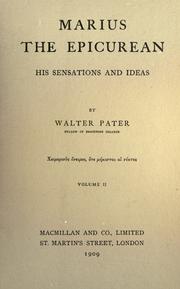
Marius is born in the second-century Roman Empire to a patrician family. In his youth he takes in the rituals, religion, and surroundings of his native land, and when his parents die, he’s sent away to a boarding school. As young Marius develops into manhood, he explores various schools of philosophy and ways of life, until he lands into the position of amanuensis to the emperor Marcus Aurelius —who of course is not just the head of the largest empire the world had yet seen, but also a respected thinker and philosopher of Stoicism. Marius dips into Stoicism himself, until a fledgling new religion catches his attention: Christianity. Marius’s search for meaning gives Pater a broad canvas on which to expound on some of the central theses he would return to often in his career: how childhood experiences are essential to the personality of the adult, and how a carefully-curated, aesthetic life—but not one of pure hedonic abandon—is one of the most satisfying ways to live. Indeed, Pater is careful to distinguish Epicureanism and its emphasis on modest sensory pleasures and limiting desire, from hedonism and the ruin a life of pure consumption can bring. Despite this focus on philosophical searching, Pater also puts the conflict Marius feels over religion at the story’s forefront. Like Pater himself, who yearned for the simpler atmosphere of religion he had experienced in youth, Marius finds himself bouncing from paganism, to philosophy, to the new religion of Christianity, in search of the comfort of the lost rituals of his youth. In the end, a satisfactory peace seems elusive. Marius the Epicurean remains an important milestone in 19th century investigations of religion and philosophy, while also being a rich example of a text brought alive with allusion and experiments in form. The story isn’t a straightforward narrative, but rather features frame narratives, epistolary fragments, orations, and dialogues. This structure looks forward to the modernism that would emerge in 20th century literature. Literary critic Harold Bloom called it “one of the more remarkable fictional experiments of the late nineteenth century.”
Reading Progress
Sign in to track your current chapter and mark books as completed.
Links
Jump straight to the places this book is available online. LiteratureMenu labels each destination by site and adds an Amazon affiliate link when it can be matched safely.
Use this form for metadata problems, missing links, or anything that does not fit the dedicated genre and tag suggestion boxes. Admins will review it before changing the live page.